Sold scope matches delivered scope
Public Agent pages, setup questions, approval rules, pass-through cost policy, and QA checks stay aligned so buyers are not sold one thing and delivered another.
You get repeat work removed without losing control of setup, connected tools, approvals, live work, cost records, exceptions, QA, or releases.
Buyer controls
AI Team keeps the operating stack focused so clients can evaluate scope, access, approvals, cost control, run history, and QA without maintaining extra tools.
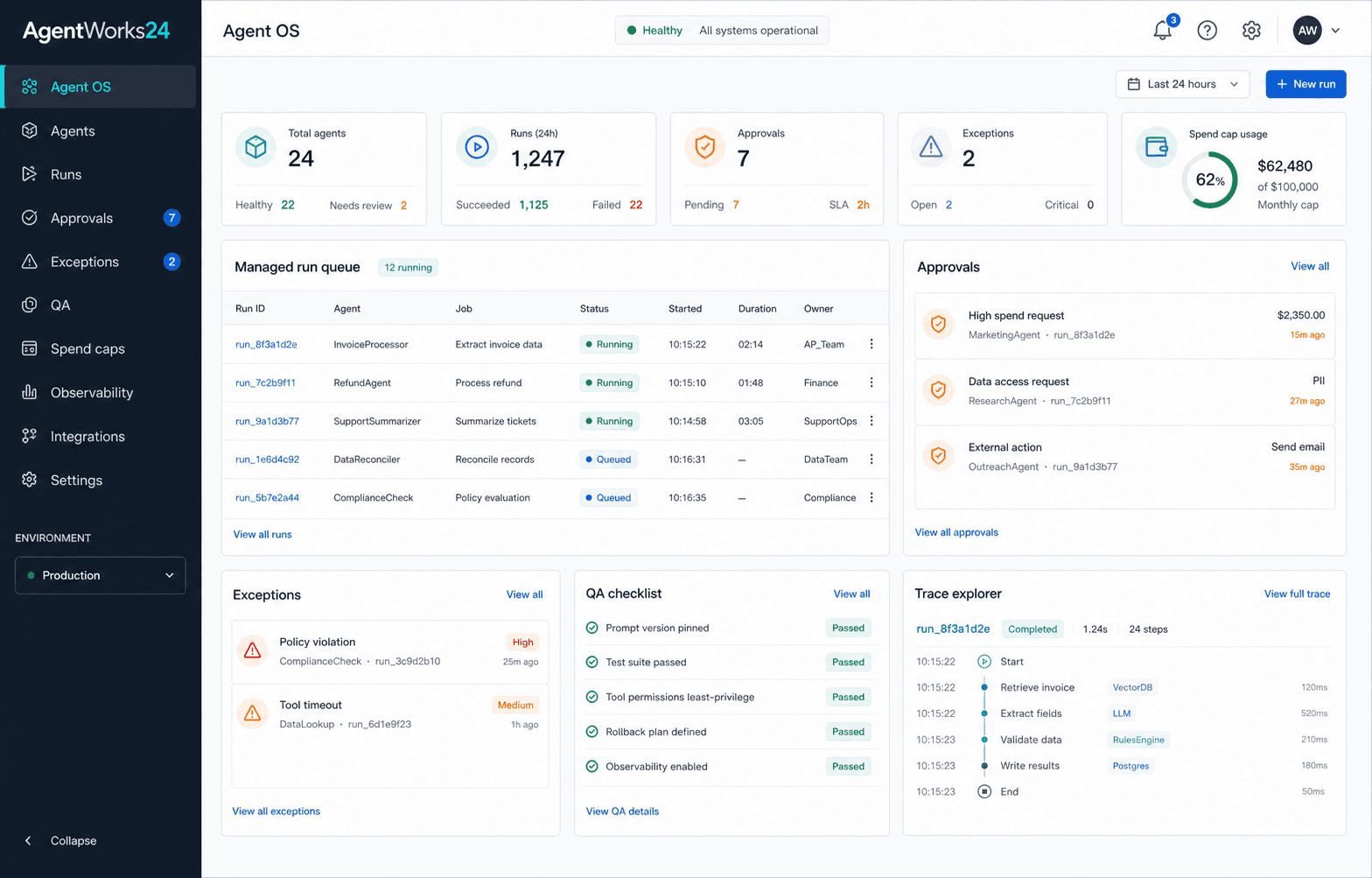
Controls
The operating controls reduce manual oversight while preserving setup discipline, clear run history, budget control, and rollback paths.
Public Agent pages, setup questions, approval rules, pass-through cost policy, and QA checks stay aligned so buyers are not sold one thing and delivered another.
Long-running tasks can retry, pause, wait for approval, escalate, or roll back without relying on someone to track every step manually.
Tool use, approvals, exceptions, and outputs are constrained so the Agent cannot quietly expand beyond the agreed work.
Model usage can move to lower-cost routes such as GLM-5.2 while keeping premium fallbacks, budgets, allowlists, and usage records in place.
Run history, errors, audit events, cost events, and QA samples show what happened instead of forcing operators to guess.
Client data, roles, credentials, and operator work stay separated through login controls, database rules, server-side secrets, and access review.
Lifecycle
A repeatable lifecycle lets AI Team sell a full catalog while still checking each client deployment before live work starts.
The public Agent page comes from the canonical catalog source.
You submit a setup request without sending secrets.
AI Team confirms the work, connected systems, access method, approval rules, and pass-through costs.
The Agent template is configured, versioned, tested, and checked through deployment QA.
Live work is supervised through approvals, exceptions, cost records, dashboard metrics, and incident paths.
Template improvements move through staging, QA, release, and rollback controls.
Platform links
These pages show the policies that help buyers decide whether to connect systems, approve costs, and let an Agent reach live work.
FAQ
These answers explain why AI Team uses a focused stack instead of adding tools that duplicate the same controls.
Buyers need setup gates, approval records, credential controls, cost caps, QA, incident paths, and operator review before live work spans multiple systems. Simple scripts do not give enough control once customer, finance, or operational work is involved.
Clients should not need to maintain another automation tool to get repeat work removed. AI Team keeps the operating stack focused so setup, approvals, cost control, QA, reporting, and incident review stay managed by AI Team.
Agent definitions, approval rules, credentials, spend caps, and dashboard metrics move through versioning, deployment QA, incident paths, and rollback controls before material changes reach clients.
No. AI Team can use a cost-efficient workhorse route such as GLM-5.2 after quality checks pass, while preserving premium fallbacks or client-specific routes when security, quality, latency, modality, or contract requirements demand them.